Two related names, different layouts
The original watch Rolex calls Explorer is often called Explorer I in replica listings. Rolex currently offers it in 36 mm and 40 mm with calibre 3230 and a black dial with 3, 6 and 9 numerals. The original Explorer II is 42 mm, uses calibre 3285 and adds a date, an orange 24-hour hand and a fixed graduated bezel. These are original-model identifiers, not verified specifications for any replica.
| Feature | Explorer | Explorer II |
|---|---|---|
| Main display | Time only, 3-6-9 dial. | Time, date and 24-hour indication. |
| Current original sizes | 36 mm or 40 mm. | 42 mm. |
| Bezel role | No external time scale. | Fixed 24-hour scale. |
For Explorer, inspect proportion and legibility
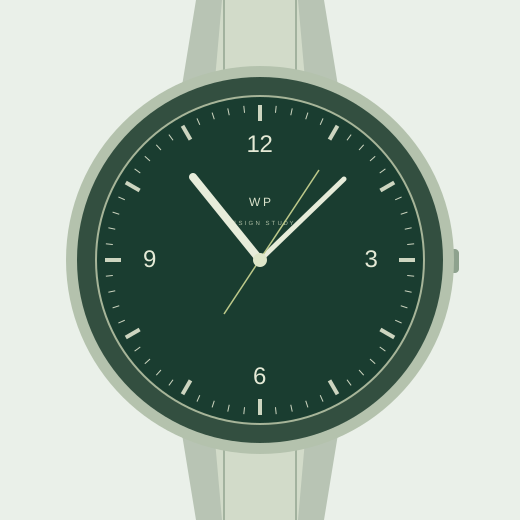
On a simple dial, hand lengths, numeral alignment and the minute track become the main visual checks. Request a clear front photograph showing the minute hand against the outer markers. Ask for a side view to compare crystal height and case thickness, especially when a seller offers both size labels.
Check the supplied bracelet's shortest fit and the reach of its first rigid links. A compact dial photograph does not tell you how far the watch extends across the wrist. Compare the actual lug-to-lug measurement with a comfortable existing watch. Ask whether the crown has any unused calendar-setting position.
For Explorer II, make the extra hand earn its place
The orange hand on the original Explorer II completes a rotation in 24 hours. With the fixed scale, this distinguishes day from night and supports a reference-time display. A replica needs its own demonstration: ask whether the extra hand moves on that cycle and how it is adjusted.
Have the seller explain which crown position sets local time, reference time and date on the installed movement. Ask whether the ordinary hour hand adjusts independently, rather than accepting an answer that merely says GMT works. Request a date-change demonstration and a view of the hand stack so its clearance can be assessed.
Do not confuse its bezel with GMT-Master II
The original Explorer II's bezel is fixed. The GMT-Master II uses a rotating 24-hour bezel. Establish whether the replica follows the layout it claims to copy; a sales description that treats these as the same operation needs clarification. When comparing white and black Explorer II dials, inspect hand contrast and date-disc presentation on the actual version offered.
Ask for measured diameter, thickness and bracelet adjustment range before selecting a 42 mm configuration. A larger numerical size may be manageable on one wrist but extend beyond another because of end-link shape. A wrist photo is most useful when its wearer states their circumference.
Which guide should you follow next?
Choose Explorer if your comparison centres on an uncluttered time-only display. Choose the Explorer II layout if a date and 24-hour indication are part of the intended use. Confirm the replica's movement and spare-part options in either case. Outdoor imagery does not prove shock resistance, water resistance or original Rolex certification.
For a rotating travel bezel, read GMT-Master II replicas. For other time-only dial colours and case sizes, compare Oyster Perpetual replicas.
Reference sources
- Rolex Explorer featuresOriginal Explorer 36/40 mm dimensions, 3-6-9 dial and calibre 3230; checked 13 October 2026.
- Rolex Explorer II featuresOriginal Explorer II 42 mm size, date, 24-hour hand and calibre 3285; checked 13 October 2026.
- Rolex Explorer II, reference 226570Original fixed 24-hour bezel, 42 mm diameter and independent local-hour setting; checked 13 October 2026.