Identify the original model being copied
Rolex offers the original Day-Date in 36 mm and 40 mm, with calibre 3255, a date window and the day of the week written in full. The family is made in precious metals and is associated with the President bracelet. These facts describe original Rolex watches. A gold-coloured or platinum-coloured replica should not inherit the original's material description.
Write the model name consistently as Day-Date when comparing references. The calendar layout distinguishes it from a Datejust: the weekday is an additional display, not a different label for the date numeral. A listing with only a working date does not reproduce the complete dual-calendar function.
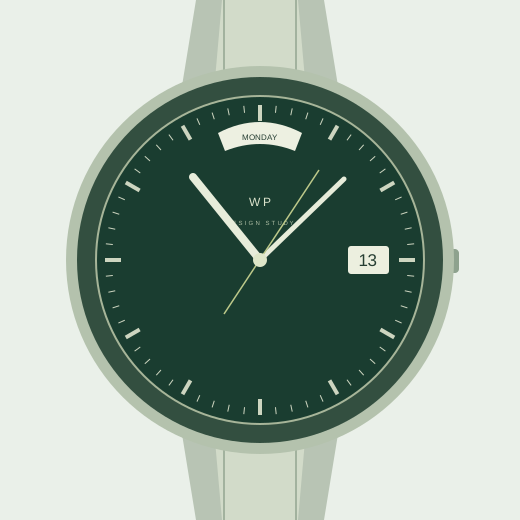
Read every weekday, not just the first photo
Ask which language is installed and request images of all seven days. Check spelling, spacing and whether long words fit within the aperture. The word should sit in a consistent position across the week, rather than appearing correct only for the shortest day name.
Request date examples from different parts of the month as well. Inspect both displays straight on, then at a slight angle to understand how the crystal and date lens affect the view. Ask whether the day and date discs shown in the listing are the ones supplied; some sellers reuse pictures across configurations.
Have both calendar functions demonstrated
Get the operating instructions for the installed movement before attempting any calendar changes. In a video, ask the seller to show the permitted day and date adjustments, then advance the time through a calendar change. Observe whether both indicators move and how they settle in their windows.
The original Day-Date changes the two displays around midnight through its own mechanism. A replica may use a different transition or setting method. Ask what the actual watch does and record that answer. A statement that the movement is automatic does not explain its calendar behaviour or prove that both discs work.
Compare size and finish as separate decisions
Choose between a 36 mm and 40 mm configuration using actual measurements. Request thickness, lug-to-lug length, bracelet adjustment range and the weight of the supplied watch. Compare these with a watch that already fits, rather than assuming the larger model is more suitable because it is more prominent in photographs.
For a coloured finish, ask for the base material, coating method and which surfaces are coated. Request pictures of the case back, inside the clasp and underside of the links. Colour words describe appearance; they do not establish solid gold, platinum content or the durability of a coating.
Inspect the President-style bracelet
The bracelet's rounded three-piece link appearance is a major part of the design. Check the articulation of the links, end-link seating and the operation of any concealed clasp. Ask how the bracelet is resized, what tools are needed and whether spare links are available in the same finish.
Before purchase, clarify the response to a misspelled weekday, a stuck disc or a clasp that will not stay closed. Ask for the movement designation and a service route for the dual calendar. None of these details can be established from an engraving or the model name alone.
This comparison suits readers who want a weekday display and a formal bracelet configuration. For a date-only layout with different bezel and bracelet choices, read the Datejust guide.
Reference sources
- Rolex Day-Date featuresOriginal 36/40 mm sizes, calibre 3255, precious-metal construction, full weekday display and President bracelet; checked 13 October 2026.